
The Modernists
Interpretive signage along the Country theme
The Modernists
“I don’t want to give the impression that I love the bush, and because I love it I want other people to love it. I simply want to paint pictures from it.”
Artist, Fred Williams[1]
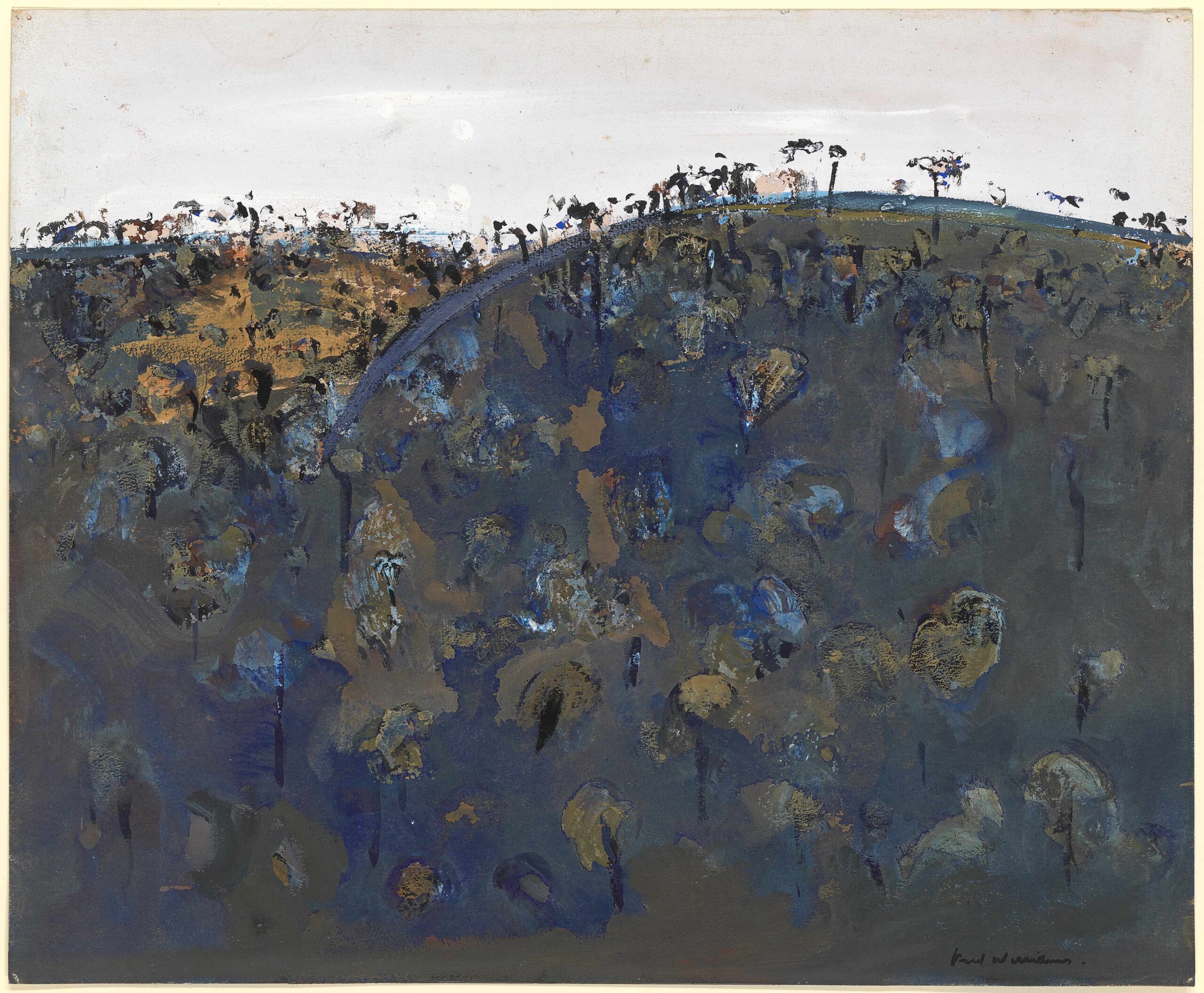
Fred Williams was one of Australia’s most recognised and significant landscape artists of the late 20th century, whose works marked a departure from the traditional depictions of the Australian landscape. Williams’ great inspiration was the French artist, Cézanne and he painted in the classic Modernist manner of flat picture planes. He travelled to London in 1951, working for a picture framer and studying art. On returning to Australia, Williams was struck by the contrast between the Australian landscape and the orderly nature of England. Later, his wife Lyn would recall: “His friends said, ‘why do you want to do the Australian landscape?’ and he said ‘I think I can add something to that story. Something that’s not there’.”[2]
In 1963, Williams and his family moved to Upwey, in the foothills below the Dandenong Ranges National Park. With his studio situation at the base of the valley, it became the inspiration for his iconic Upwey series. With their trademark high horizons and dense treescapes inspired by the hillside looking towards Tremont, Williams introduced his audience to a new kind of Australian landscape.
As you continue along the ngurrak barring trail, you’re invited to further explore the deep cultural and creative history of the Dandenong Ranges through five key themes: Ways of Seeing, Community, Activism, Resilience and Country.
ngurrak barring acknowledges the Wurundjeri people as the Traditional Owners and Custodians of these lands and waterways. We pay our respects to all Elders, past, present, and emerging, who have been, and always will be, integral to the story of our region.
[1] J Mollison, ‘Williams, Frederick Ronald (Fred) (1927–1982)’, Australian Dictionary of Biography, https://adb.anu.edu.au/biography/williams-frederick-ronald-fred-15774
[2] https://www.smh.com.au/culture/art-and-design/like-he-didn-t-want-to-get-caught-fred-williams-as-we-ve-never-seen-him-before-20221007-p5bnz5.html
More
This is just placeholder text. Don’t be alarmed, this is just here to fill up space since your finalised copy isn’t ready yet. Once we have your content finalised, we’ll replace this placeholder text with your real content.
Signage Text
“I don’t want to give the impression that I love the bush, and because I love it I want other people to love it. I simply want to paint pictures from it.”
Artist, Fred Williams
Fred Williams, one of Australia’s most recognised landscape artists of the late twentieth century lived at Allawah, St Kilda Avenue, Upwey from 1963 to 1969. The property was located in the foothills below the Dandenong Ranges National Park.
The hillside towards Tremont became the inspiration for his iconic Upwey series of landscapes with their high horizons and dense treescapes painted in the classic Modernist manner of flat picture planes. His great inspiration was the French artist Cézanne.
In his earlier Sherbrooke series, he painted the giant mountain ash trees, so tall that there is no visible horizon, while in the following You Yangs series he used the aerial mountaintop view to paint the outlook of the plains with the scattering of trees along roads and fence lines.
It was not his aim to paint the scenic views of a region but the essence of the countryside, to focus on its monumentality.
Lyn Williams (Fred Williams’ widow)
The Modernists
You can find this sign along XXXXX
More
This is just placeholder text. Don’t be alarmed, this is just here to fill up space since your finalised copy isn’t ready yet. Once we have your content finalised, we’ll replace this placeholder text with your real content.
Sometimes it’s nice to put in text just to get an idea of how text will fill in a space on your website.